
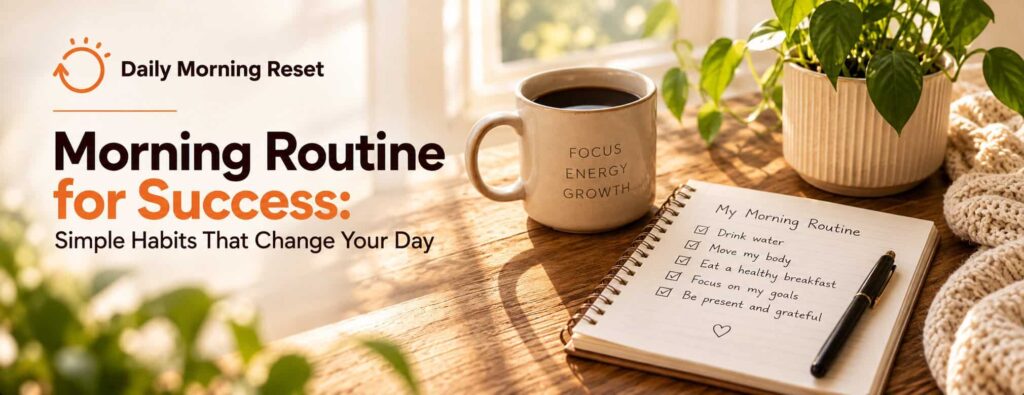
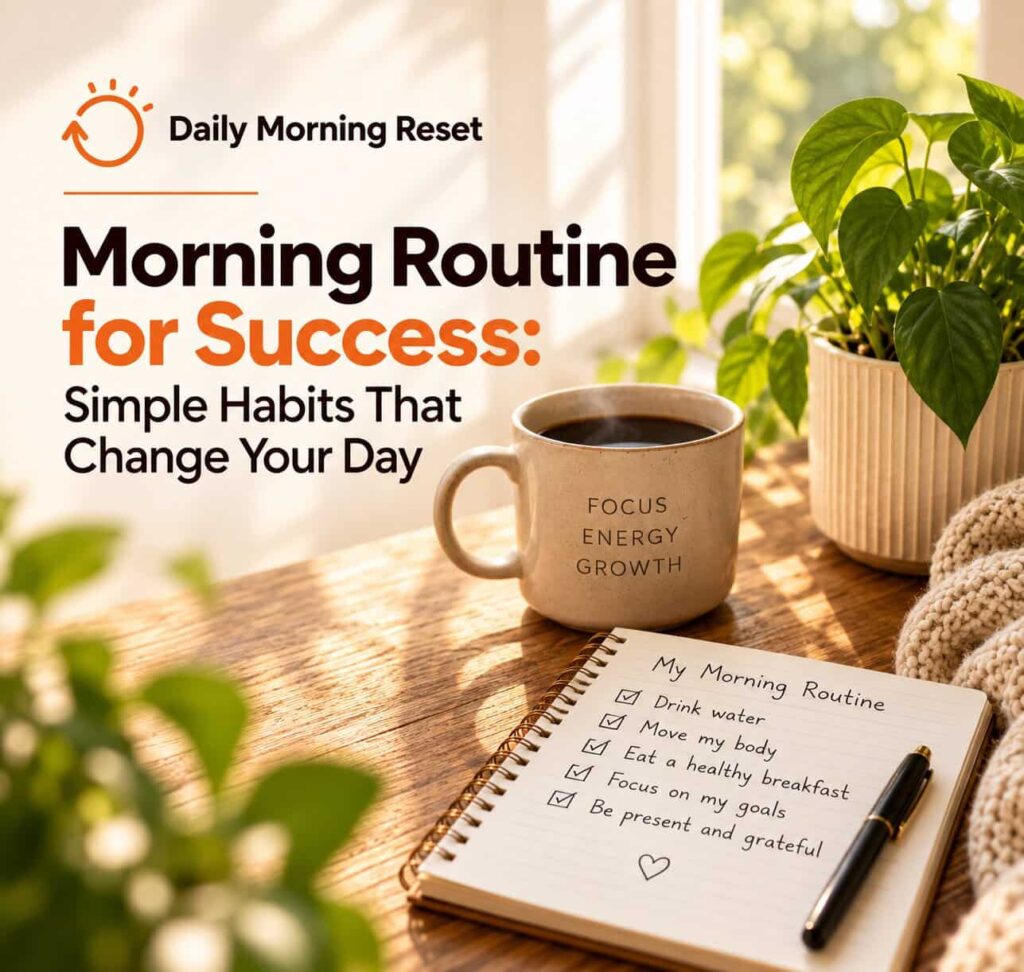
A good morning does not require waking at 5 a.m. or following a two-hour routine. You also do not need cold showers, long workouts, or a perfect breakfast.
A morning routine for success is much simpler. It gives you time to wake, think, and choose how your day begins.
That matters even more in 2026. Most people wake beside a phone filled with messages, news, email, and social feeds. One quick check can turn into twenty minutes of reacting to other people.
A morning routine for success creates a short gap between waking up and dealing with those demands. That gap can be ten minutes, twenty minutes, or longer when your schedule allows.
The goal is not to create a morning that looks impressive online. A useful morning routine for success should help you feel calm, clear, and ready for the day ahead.
Table of Contents
What Is a Morning Routine for Success?
A morning routine for success is a small group of habits you repeat after waking. These habits help you move from sleep into the rest of your day with more direction.
The routine does not need to be long. It can include water, light movement, quiet time, planning, reading, or a healthy breakfast.
A useful routine may help you:
- Start your day without rushing
- Protect your attention from early distractions
- Decide what matters most today
- Make time for basic movement
- Reduce small choices each morning
- Build better habits through daily use
- Start work with a clearer direction
- Create a calmer start before outside demands arrive
The key is repetition. A morning routine for success works best when it is simple enough to use on normal days, busy days, and difficult days
The Best Morning Routines for Success Are Simple, Not Extreme
The best morning routines for success rarely need ten different habits.
Online routines often make mornings look much harder. Someone wakes before sunrise, journals for an hour, trains, reads, meditates, and makes a perfect breakfast.
That approach can work for some people. It can also become another source of pressure.
Your morning routine for success should fit your sleep, work, family, and energy. Copying someone else’s schedule can make a useful idea harder than it needs to be.
We warn against routines that become too long or rigid. It favors routines that are simple, repeatable, flexible, and built around your life.
The best morning routines for success give you enough structure to help without making mornings exhausting.
Build a Better Morning in Just 10 Minutes
Get the complete 10-minute morning routine with simple steps, practical habits, and clear guidance you can use every day.
Build a Better Morning in Just 10 Minutes
Get the complete step-by-step system with habit tracker, guided templates, and real-life examples.
Why a Morning Routine for Success Matters More in 2026
Attention is one of the biggest problems facing modern mornings.
Your phone can bring work, entertainment, news, family messages, and social feeds into bed. You can face dozens of new inputs before your feet touch the floor.
That makes a morning routine for success useful for one simple reason: it gives your attention somewhere else to go first.
Instead of starting with Instagram, email, or headlines, you might start with water and stretching. Instead of reading ten messages, you decide what deserves your focus today.
This does not mean technology is bad. It means you choose when it gets your attention.
Start by protecting your mornings from email, social media, and other interruptions. You need to build a routine around how you want to feel.
That idea still makes sense in 2026. Use technology after your morning has started, rather than letting technology start it for you.
Morning Routine : With vs. Without
With a Morning Routine
With
Without a Morning Routine
Without
More energy & focus
Groggy & distracted
Lower stress
Rushed & overwhelmed
Better decisions
Reactive, not proactive
Progress on goals
Stuck in the same cycle
Forget the Myth That Success Starts at 5 A.M.
Waking early can be useful. It can give you quiet time before work, children, calls, or other demands begin.
But waking at 5 a.m. is not the goal.
If an early alarm cuts your sleep and leaves you tired all morning, it works against your morning routine for success.
Use a precise 5:55 a.m. wake time. The useful lesson here is the consistency, not the exact hour. Also protect your personal time before checking email.
Ask yourself a better question than “How early should I wake up?”
Ask: How can I use the first part of my day better?
Your Morning Routine for Success Starts the Night Before
A calm morning routine for success becomes easier when you remove small problems the previous evening.
Think about what slows you down after waking. You cannot find clothes, your desk is messy, your water bottle is empty, and you have no idea what needs doing first.
Each problem adds another choice.
You need to prepare a few things beforehand to make the right actions easier when morning arrives.
Try preparing these before bed:
- Choose tomorrow’s clothes
- Fill your water bottle
- Place your journal somewhere visible
- Clear your desk or morning space
- Write tomorrow’s main task
- Put your phone away from the bed
- Prepare anything needed for breakfast
- Reduce screen use before sleeping
Write down key tasks before bed and removing devices from your sleep area. Calmer evening habits can make the next morning easier to start.
You do not need another large evening routine. Prepare enough to make tomorrow easier.
A 10-Minute Morning Routine for Success
Ten minutes sounds too short to matter. That short length is also why it can work.
A ten-minute morning routine for success is easier to protect when work is busy, children wake early, or plans change.
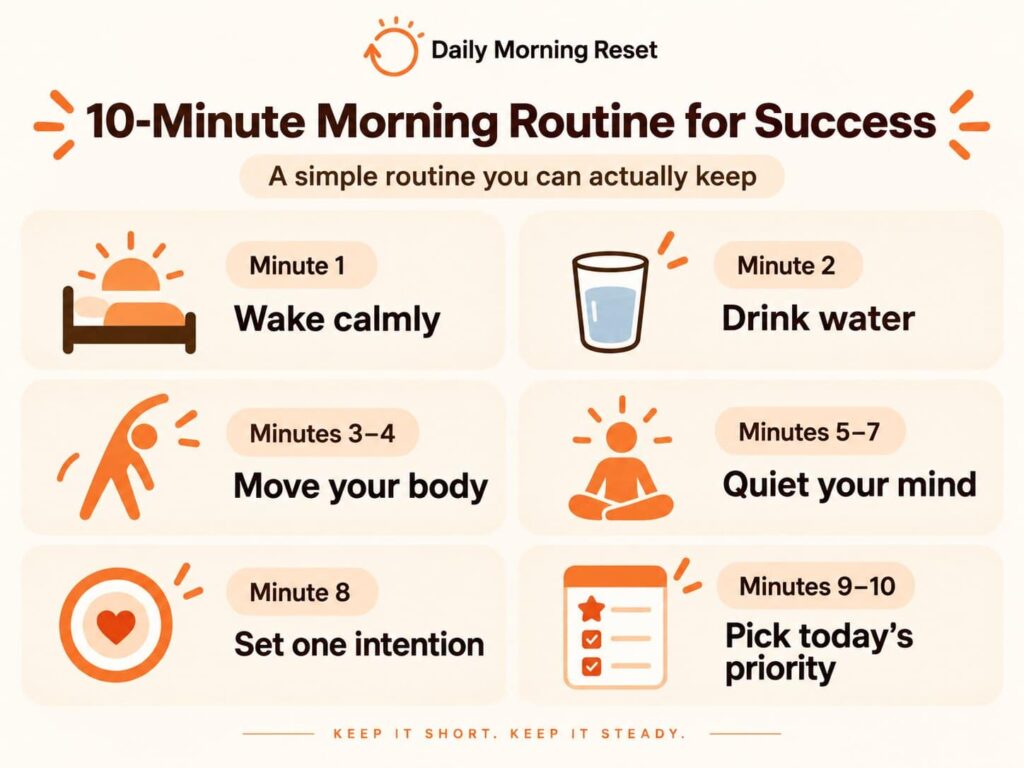
You need to build the main framework around six simple steps: wake calmly, drink water, move, get quiet, set an intention, and delay phone use.
Here is how you can use that framework tomorrow.
Minute 1: Wake Without Rushing
Your first action does not need to be dramatic.
Sit up, put your feet on the floor, and take several slow breaths. Give yourself a short moment before reaching for your phone.
This simple start creates a clear boundary between sleep and the rest of your day.
You are not trying to spend ten minutes meditating in bed. You are giving your morning routine for success a calm first step instead of starting in a rush.
If your alarm normally causes you to jump straight into action, try making the first minute slower.
Minute 2: Drink Water
Keep water ready before going to bed.
Then drinking it requires almost no thought the next morning.
Generally easy habits have fewer barriers. Water can become one of the first actions in your routine instead of another thing you must remember later.
You can also link it to something you already do.
Brush your teeth, then drink water. That simple link makes the action easier to remember each day.
Minutes 3-4: Move Your Body
You do not need a gym session before breakfast.
Start with one or two minutes.
Try:
- Shoulder rolls
- Light stretching
- Bodyweight squats
- Neck circles
- A short walk
- A few push-ups
- Gentle yoga movements
Move your body from 60 to 120 seconds..
Short movement keeps your morning routine for success realistic. You can still train later if you prefer longer workouts.
Minutes 5-7: Give Your Mind Some Quiet
Spend a few minutes without new information.
You might sit quietly, pray, breathe slowly, or simply notice what is on your mind.
Do not worry about making your thoughts disappear. The goal is just to stop feeding your mind new input for a moment.
If three minutes feels too long, begin with one.
A morning routine for success should feel manageable enough that you want to return tomorrow.
Minute 8: Set One Intention
Now decide how you want to approach your day.
Keep your intention short.
It might be:
- Focus on one thing at a time
- Finish what matters
- Stay patient
- Protect my time
- Be present with my family
- Take care of my health
- Stop avoiding the hard task
Use a short intention to give the day direction without creating another large planning session.
Scudamore also writes one daily intention rather than starting with a huge list. His goals can include work, exercise, food, or other personal needs.
This part makes your morning routine for success more than a set of physical habits. You are choosing how you want to show up that day.
Minutes 9-10: Pick Today’s Main Priority
Your intention tells you how to approach the day. Your priority tells you what deserves your best effort.
Ask one question:
What is the one thing that would make today feel successful?
Choose one answer.
Do not turn this into a list of fifteen tasks.
choosing one main outcome instead of starting the morning with too many competing goals.
Write that priority down, then finish your routine.
Your ten-minute morning routine for success is complete.
Keep Your Phone Away Until Your Routine Ends
This may be the hardest habit on the list.
Most phones stay within reach all night. That makes checking them almost automatic after waking.
One message becomes an email. The email leads to social media. Then you check news, another app, and perhaps your work chat.
Your attention has already moved elsewhere.
Protecting your phone-free time helps keep your morning routine for success focused on your own actions first.
You do not need to start with 30 minutes.
Try ten minutes first. When that becomes easy, increase the gap.
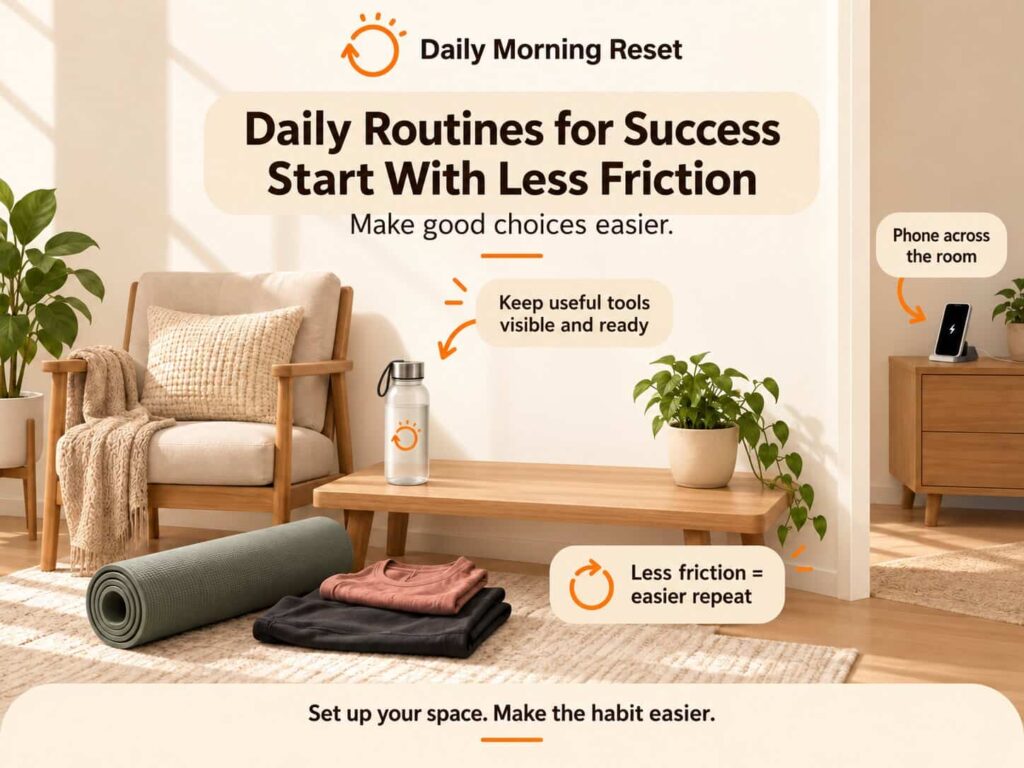
Daily Routines for Success Start With Less Friction
Many daily routines for success fail because they depend too much on motivation.
Your environment can do some of the work instead.
If your journal is already on the table, writing becomes easier. If your water is ready, drinking it takes no effort.
If your phone charges across the room, mindless scrolling becomes slightly harder.
arrange your space so useful actions require fewer choices. It suggests keeping tools such as water, journals, and exercise items ready and visible.
That approach also makes your morning routine for success easier during low-energy mornings.
A simple morning area might include:
- Water
- Notebook
- Pen
- Book
- Yoga mat
- Exercise clothes
- Chair for quiet time
- Written reminder of your routine
The goal is not creating a beautiful room.
The goal is making good choices easier.
This idea can help with many daily routines for success, not only mornings. The fewer barriers a habit has, the easier it becomes to repeat.
Build Habits Around Things You Already Do
You already have a morning routine, even if you have never planned one.
You wake, use the bathroom, brush your teeth, make coffee, get dressed, or check your phone.
Use those existing actions as reminders.
For example:
- After brushing my teeth, I drink water.
- After drinking water, I stretch.
- After stretching, I sit quietly.
- After sitting quietly, I write my intention.
- After writing my intention, I choose my main task.
Now your morning routine for success has a natural order.
Use habit-stacking approach to reduce the effort needed to remember each new step.
This is one reason simple daily routines for success tend to last longer than huge lifestyle changes.
Should Journaling Be Part of the Best Morning Routine?
Journaling can help, but it is not required.
You do not need three pages every morning. A few useful lines can be enough.
Try one prompt:
- What matters most today?
- What is distracting me?
- What would make today meaningful?
- How do I want to feel?
- What am I grateful for?
- What have I been avoiding?
If journaling makes the best morning routine for you, keep it. If you dislike writing each morning, choose a different habit.
What About Breakfast and Exercise?
There is no single breakfast that creates success.
Some people eat soon after waking. Others prefer eating later.
Choose food that supports and aids to early energy. This adds to the momentum.
Breakfast choices can differ between people. The main idea is choosing something that works for your energy and schedule.
Exercise works the same way.
If morning training helps you, include it. If a full workout makes your morning routine for success too long, keep the two-minute movement habit and exercise later.
A routine should support your day, not take over your day.
Create a Clear End Point
Your morning routine should eventually finish.
Without a clear ending, quiet morning time can slowly become another form of delay.
Choose one action that marks the start of the next part of your day.
It could be:
- Opening your laptop
- Sitting at your desk
- Checking your calendar
- Getting dressed
- Leaving home
- Starting your main task
A clear end makes your morning routine for success feel like a complete part of the day instead of an open-ended project.
Expand Your Morning Routine for Success to 20 Minutes
Some mornings give you more time.
Instead of creating a completely different routine, expand the short one.
Use a 20-minute version for days when you want more space for reflection, movement, and planning.
A simple version could look like this:
- 3 minutes: Quiet breathing or reflection
- 2 minutes: Water and a gentle start
- 5 minutes: Walking or light movement
- 5 minutes: Journaling
- 3 minutes: Intention and your main task
- 2 minutes: Reading or gratitude
This longer morning routine for success gives you more space without becoming difficult to maintain.
Use it when time allows. Keep the ten-minute version as your normal base.
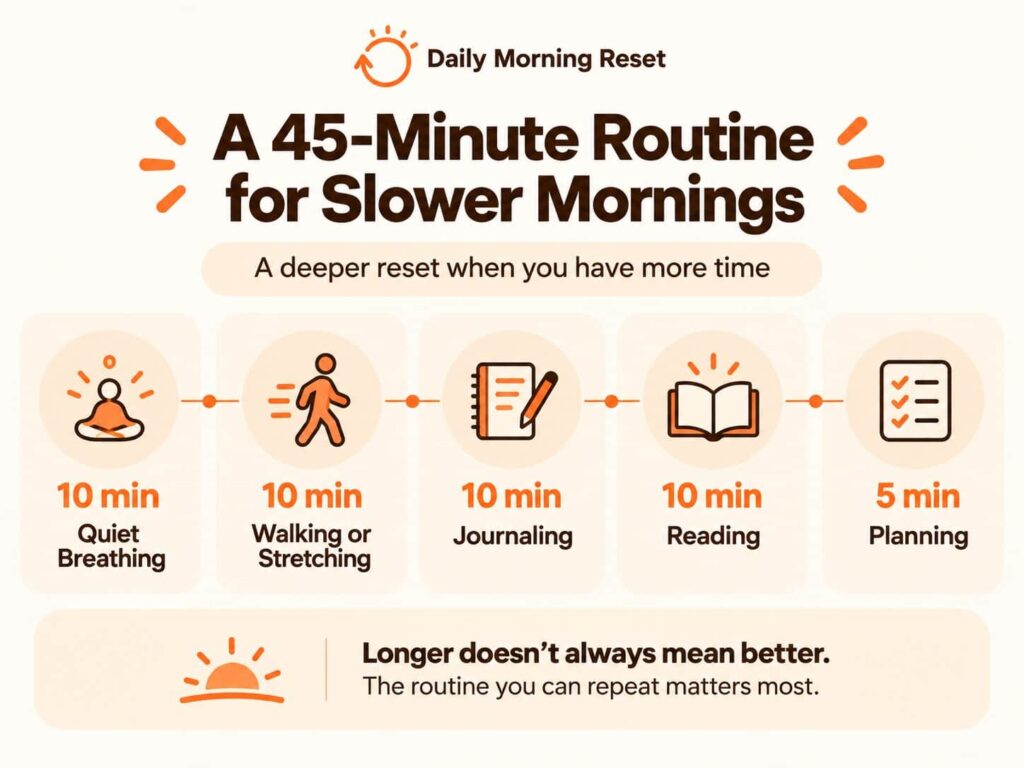
A 45-Minute Routine for Slower Mornings
You may sometimes want a deeper reset.
A 45-minute option built around longer quiet time, movement, journaling, reading, and intention.
Your version might include:
- 10 minutes of quiet breathing
- 10 minutes of walking or stretching
- 10 minutes of journaling
- 10 minutes of reading
- 5 minutes of planning
This is another form of a morning routine for success, but it should not become the minimum you force yourself to complete.
Longer does not always mean better.
The routine you can repeat still matters most.
The Two-Minute Morning Routine for Success on Bad Days
Some mornings will not go to plan.
You may oversleep, travel, wake with children, have an early meeting, or simply feel tired.
That is when a backup morning routine for success becomes useful.
We suggest a tiny version for hard days so the basic pattern stays alive.
Try:
- 30 seconds: Drink water
- 30 seconds: Breathe slowly
- 30 seconds: Stretch
- 30 seconds: Choose today’s intention
That is enough.
A routine that only works on perfect mornings is difficult to keep. A small backup gives you something you can use almost anywhere.
How to Build the Best Morning Routine for Your Life
The best morning routine is not the one with the most habits. It is the one you can maintain without fighting your schedule every day.
Start with two habits.
Perhaps you drink water and avoid your phone for ten minutes.
Keep those habits for a week. Then add movement or a short intention.
Start with two actions, repeat them, then add another once the first habits feel normal.
Creating a draft routine, testing it for around two weeks, then changing the parts that do not fit.
That is a useful way to build your own morning routine for success.
Do not ask whether your routine looks impressive.
Ask whether you will still do it next month.
Build a Better Morning in Just 10 Minutes
Get the complete 10-minute morning routine with simple steps, practical habits, and clear guidance you can use every day.
Build a Better Morning in Just 10 Minutes
Get the complete step-by-step system with habit tracker, guided templates, and real-life examples.
A 30-Day Morning Routine for Success Plan
You do not need to rebuild your life tomorrow.
Give your morning routine for success one month to take shape.
Use a four-week plan that adds habits slowly rather than forcing every change at once.
Week 1: Build the Base
For the first seven days, focus on the core routine:
- Wake calmly
- Drink water
- Move briefly
- Spend a moment in quiet
- Set one intention
- Avoid your phone until finished
Do not add more.
Your goal is making your morning routine for success familiar.
Week 2: Add One Habit
Now choose one useful addition.
You might add:
- Five minutes of reading
- Short journaling
- A longer walk
- Gratitude
- Prayer
- Extra stretching
Choose only one.
This keeps your routine light while giving it more depth.
Week 3: Fix the Night Before
Now improve your evening setup.
Prepare your clothes, water, workspace, and main task before sleeping.
Start these steps during the third week because reducing friction makes mornings easier to repeat.
These evening habits can also support other daily routines for success by reducing the number of decisions waiting for you tomorrow.
Week 4: Make It Yours
Now look at the past three weeks.
Which habits helped?
Which ones felt pointless?
Which steps kept getting skipped?
Remove what does not fit. Change the order. Adjust the length around your real schedule.
Stop copying a template and start shaping a routine around your own needs.
By now, your morning routine for success should feel more personal and less like a challenge.
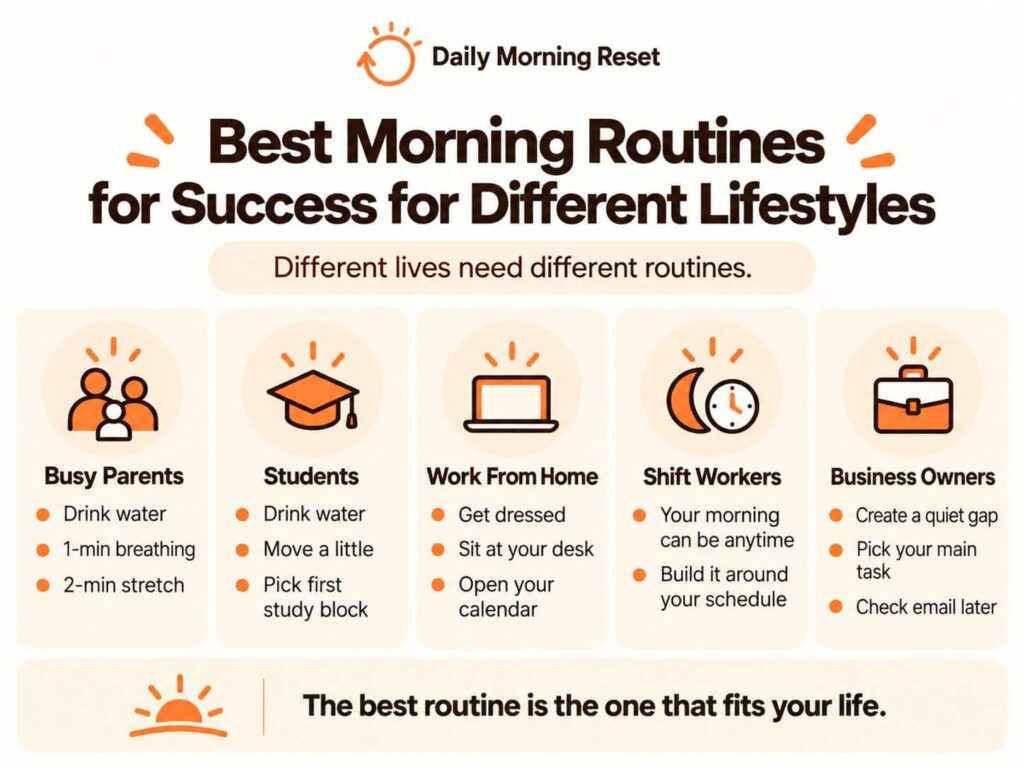
Best Morning Routines for Success for Different Lifestyles
The best morning routines for success do not look identical because people’s lives are not identical.
For Busy Parents
Keep your routine short enough to finish before the house becomes busy.
Try water, one minute of breathing, two minutes of stretching, and one intention. If the children wake first, use the two-minute backup instead.
For Students
Focus on a clear transition into study.
Drink water, move, avoid social feeds, and decide which task deserves your first focused block.
For People Working From Home
Create a strong end point.
Your routine might end when you get dressed, sit at your desk, and open your work calendar.
For Shift Workers
Your “morning” does not need to happen in the morning.
For Business Owners
Use your routine to create a quiet gap before decisions start arriving.
A short morning routine for success can help you identify your main task before email and work requests take control.
Common Morning Routine Mistakes
Even the best morning routines for success can fail when they become too hard to maintain.
Trying to Change Everything at Once
Starting eight new habits creates eight new points of failure.
Pick two and build from there.
Copying Someone Else’s Wake Time
A 5 a.m. alarm is not useful if you regularly sleep at midnight.
Choose a time that fits your life.
Checking Your Phone “For One Minute”
One message often leads to another.
Complete your short routine first.
Making the Routine Too Long
A 90-minute plan may feel exciting for three days.
Then work gets busy.
Keep a short version ready.
Treating One Missed Day as Failure
Missing one day does not erase your habit.
Measuring Success Only Through Work
A morning routine for success should not exist only to help you complete more tasks.
It can also help you feel calmer, healthier, less rushed, and more present with other people.
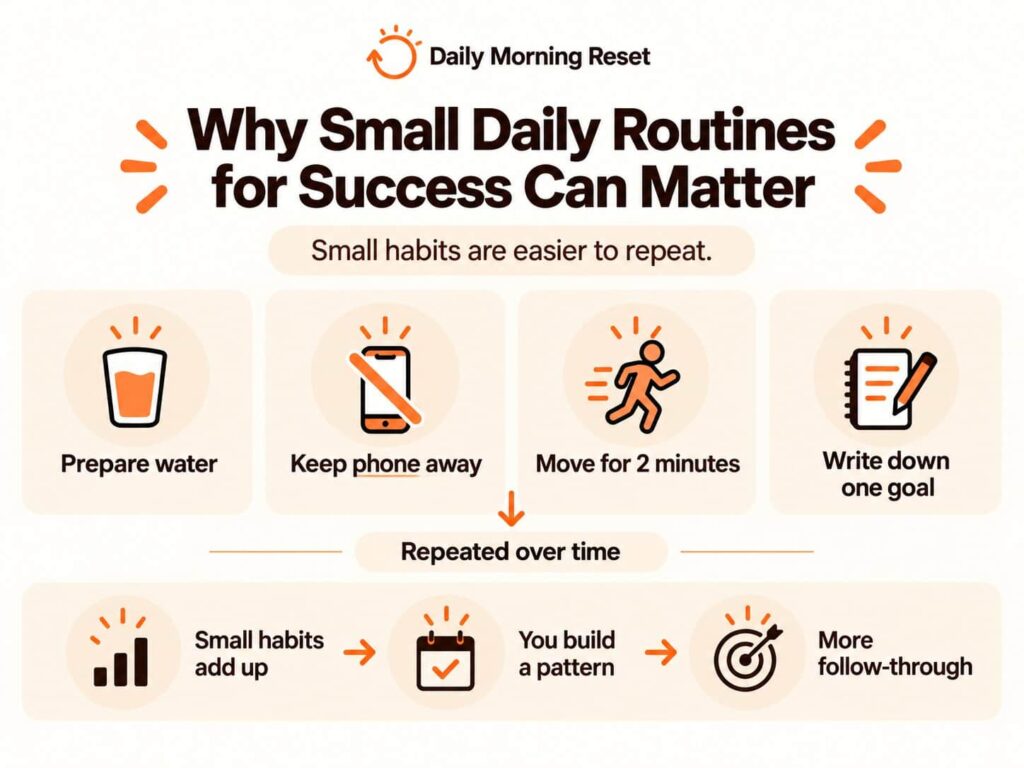
Why Small Daily Routines for Success Can Matter
Large goals get most of the attention.
Daily behavior does much of the actual work.
Small daily routines for success give you actions you can repeat instead of waiting for the perfect mood.
You prepare water. You keep your phone away. You move for two minutes. You write down one goal.
None of these actions looks impressive alone.
Repeated over time, they create a pattern.
That is one of the strongest reasons to keep a morning routine for success small.
Small habits give you more chances to follow through.
A Simple Morning Routine Checklist
If you want to start tomorrow, use this basic version:
- Wake without immediately checking your phone
- Drink a glass of water
- Move for one or two minutes
- Spend two or three minutes quietly
- Write one intention
- Choose your main task
- Start your day
- Use a longer version only when time allows
This checklist combines many habits found across the best morning routines for success without turning your morning into another project. You can find out more about our morning routine checklist in our comprehensive article.
Build a Morning Routine You Can Actually Keep
There is no secret schedule that guarantees a successful life.
There is no prize for waking earlier, journaling longer, or completing more habits before breakfast.
A useful morning routine for success gives you something far more practical: a small part of the day you can shape yourself.
Start with ten minutes.
Wake calmly. Drink water. Move your body. Spend a few moments without new input. Decide how you want to approach the day and what matters most.
Keep your phone away until you finish.
Prepare a few things the night before so tomorrow starts with less friction.
When you have more time, expand the routine. When life gets messy, use the two-minute version.
The Morning Routine For Success eBook My Entire Life takes this idea further with practical routines you can actually follow. It is a community favorite for a reason: it keeps mornings simple, flexible, and realistic.
That is what the best morning routine should do.
It should not make your life look perfect.
It should make the start of your day easier to own.
Build a Better Morning in Just 10 Minutes
Get the complete 10-minute morning routine with simple steps, practical habits, and clear guidance you can use every day.
Build a Better Morning in Just 10 Minutes
Get the complete step-by-step system with habit tracker, guided templates, and real-life examples.
Morning Routine For
Success eBook
FAQs
What Is the Best Morning Routine?
Drink water, move briefly, avoid your phone, and choose one main goal. The best routine is one you can repeat.
How Long Should It Be?
Start with ten minutes. Keep a two-minute version for busy mornings.
Should I Avoid My Phone?
Wait until your routine is finished before checking email or social media.