

You wake up at 7:40. Work starts at 9, you are still tired, and the idea of journaling, meditating, stretching, reading, exercising, and making a perfect breakfast sounds ridiculous.
That is where most morning routine advice loses people. It is written for the morning you wish you had, not the one you actually wake up to.
A useful morning routine checklist should still work when you slept badly, woke up late, or have an early meeting. It should help you get moving without turning the first hour of your day into another project.
For most people, the best morning routine checklist is pretty simple: get out of bed, get some light, drink something, move around, get ready, and decide what deserves your attention first.
Table of Contents
The Easy Morning Routine Checklist You Can Follow Daily:
You do not need to complete every habit below. Start with the basics that help you feel awake, ready, and clear about what matters today. Add anything else only if it genuinely makes your morning easier.
- Get up and open the curtains
- Drink water
- Wash up and get dressed
- Move for a few minutes
- Eat breakfast if you are hungry
- Choose your main priority
- Start the day without rushing
1. Start With the First 15 Minutes
The first part of the morning is where time disappears fastest.
You wake up, check the time, see a message, and reply. Then you notice an email. While you are there, you open Instagram for a minute.
Twenty minutes later, you are still in bed.
There is nothing wrong with checking your phone in the morning. The problem starts when you do it before deciding what you actually want to do.
Getting out of bed first makes a bigger difference than people expect.
Open the curtains. Go to the bathroom. Drink some water. Make coffee. Do whatever normally tells your brain that the night is over.
You do not need a strict no-phone rule. Give yourself ten minutes before you start scrolling and see how different the morning feels.
If snoozing is the bigger problem, move your alarm somewhere you need to reach. There is no need to put it on the other side of the house. Making yourself sit up or stand is usually enough to break the loop.
This is also why I would not start a morning checklist with meditation or a workout. Getting up properly comes first.
2. Keep the Basic Stuff Basic
Morning habits have a strange way of becoming complicated online.
Take water. You have been asleep for several hours, so having a drink after waking makes sense. That does not mean you need a special morning mixture with six ingredients.
Plain water is fine.
Coffee is fine too.
If making coffee is one of the things that gets you into the kitchen and properly awake, it already has a place in your routine.
The same goes for breakfast. Some people wake up hungry, while others do not want food until later. There is no reason to force yourself into either camp.
If you want breakfast, keep it simple enough that you will actually make it. Eggs, toast, yogurt, oats, fruit, or yesterday’s leftovers all work.
If you are not hungry yet, eat later.
A healthy morning routine checklist should make mornings easier. It should not turn water, coffee, and breakfast into a set of rules you have to follow correctly.
Light belongs in this same basic category.
Open the curtains when you get up. If you can step outside for a few minutes, even better.
That might mean drinking coffee on the balcony, walking to the shop, or standing outside while the dog does its thing.
There is no need to call it a sunrise routine.
You are simply getting out of a dark room and giving yourself a few minutes away from a screen.
3. Move, but Be Realistic About What That Means
If you love working out early, there is no reason to change it.
For everyone else, movement does not need to mean a 45-minute session before work.
You might stretch your back while the kettle boils. You might walk around the block before sitting at your desk. You might do a few squats because your legs feel stiff.
That is enough to count.
The mistake is deciding that morning movement only matters when it looks like exercise.
It does not.
Some mornings you will have energy and go for a longer walk. Other mornings you will stretch for three minutes and move on.
That is normal.
A routine becomes easier to keep when you stop asking every habit to be perfect.
The same idea applies to getting ready.
If you work from home, it is very easy to open your laptop too early. You check Slack or email before showering, reply to one thing, then another, and suddenly it is 11:30 and you are still wearing sleep clothes.
That happens more often than people admit.
Getting washed and dressed before work creates a useful break. You feel like the day has actually started instead of slowly leaking out of bed.
This is one reason a practical morning routine checklist for adults should include ordinary things like brushing your teeth and changing clothes. Not everything has to be about productivity.
4. The One Part of Morning Planning Worth Keeping
You do not need a detailed planning session every morning.
You probably already know what your day looks like.
What helps is deciding which one thing you do not want to keep pushing aside.
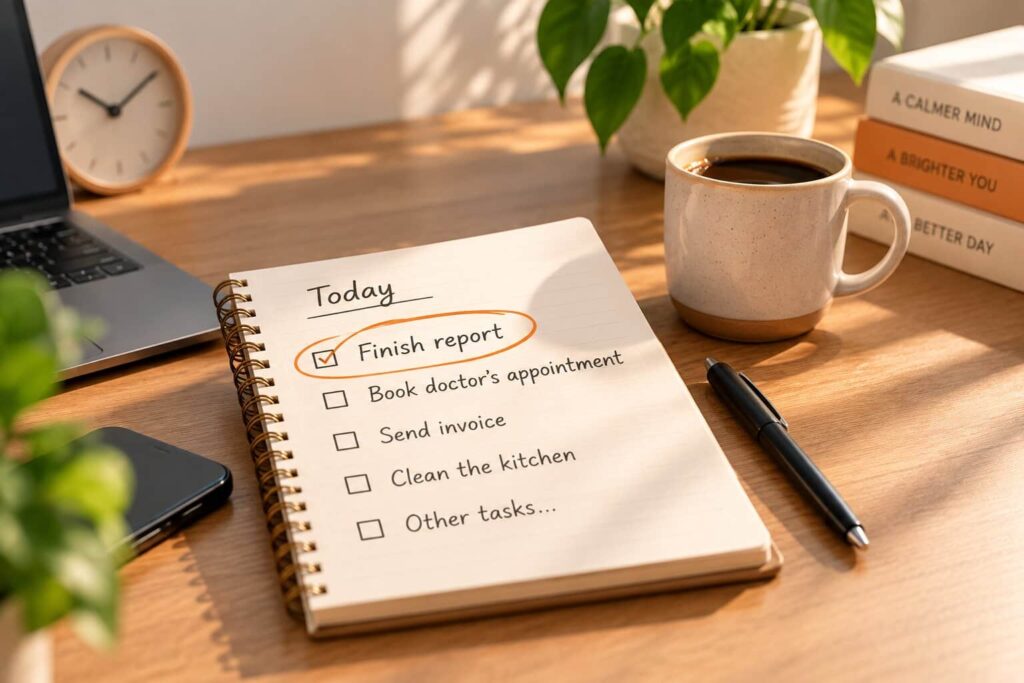
Ask yourself: if I finish one useful thing today, what should it be?
Maybe it is a report you have delayed for two days. Maybe it is booking a doctor’s appointment, sending an invoice, or cleaning something you keep ignoring.
Write it down.
This takes less than a minute, but it gives the day a center.
Otherwise, small tasks can take over surprisingly quickly. You answer emails, reply to messages, check something for a colleague, move a meeting, and suddenly half the day has gone.
You were busy, but nothing important moved.
That is why I prefer one clear priority over a long morning to-do list.
You can still have six other tasks. Just know which one matters most.
This is also where a daily morning routine checklist becomes useful. You are not trying to plan your entire life before breakfast. You are simply deciding where your attention should go once the routine is over.
5. Leave a Little Empty Space
This part is easy to overcomplicate too.
Some people call it meditation. Some call it mindfulness. Some journal.
You can also sit with coffee for five minutes and do absolutely nothing.
That works.
The point is to have a few minutes where nobody is asking anything from you.
Most days get noisy fast. Emails arrive, work begins, family members need things, and notifications keep showing up.
Having even five quiet minutes before that can make the morning feel less crowded.
If you like reading, read a few pages. If prayer is part of your morning, make space for it. If journaling genuinely helps, keep a notebook nearby.
If you hate journaling, stop forcing it.
A habit does not become useful because it appears in every article about morning routines.
At Daily Morning Reset, the point is to build a routine around your actual life, not collect as many “good” habits as possible. The Morning Routine for Success ebook follows the same idea and helps you put together a routine that feels realistic.
Build a Better Morning in Just 10 Minutes
Get the complete 10-minute morning routine with simple steps, practical habits, and clear guidance you can use every day.
Build a Better Morning in Just 10 Minutes
Get the complete step-by-step system with habit tracker, guided templates, and real-life examples.
What Happens When You Only Have 10 Minutes?
This is where you find out whether your routine is actually practical.
Say you overslept.
You have ten minutes before you need to leave or log in for work.
Forget the full routine.
Open the curtains, drink something, wash up, get dressed, and decide what needs your attention first.
If you have another minute, stretch or walk around.
That is enough.
There is no point trying to squeeze reading, journaling, meditation, exercise, and breakfast into ten minutes because they happen to be on your usual list.
A good routine should shrink when life gets busy.
I would actually recommend keeping two versions: your normal routine and your rushed routine.
Your normal version might take twenty or thirty minutes. Your rushed version might take five.
This is much more useful than trying to force the same routine every day.
It also helps when you travel, have an early call, or simply wake up feeling awful.
A Slower Morning Should Actually Feel Slower
The other mistake happens when people have more time.
You get forty minutes instead of fifteen, then immediately fill the extra time with more habits.
Now you have journaling, reading, stretching, planning, exercise, a long breakfast, and a meditation app.
Your relaxed morning has turned into a schedule.
If you have more time, leave some of it empty.
Drink coffee without doing something else. Sit outside. Take a longer shower. Walk without tracking the walk.
You do not have to use every spare minute to improve yourself.
That is one of the biggest problems with modern morning routine advice. It often treats mornings like a productivity contest.
Sometimes the best part of a good morning is simply not rushing.
Forget the 5 AM Rule
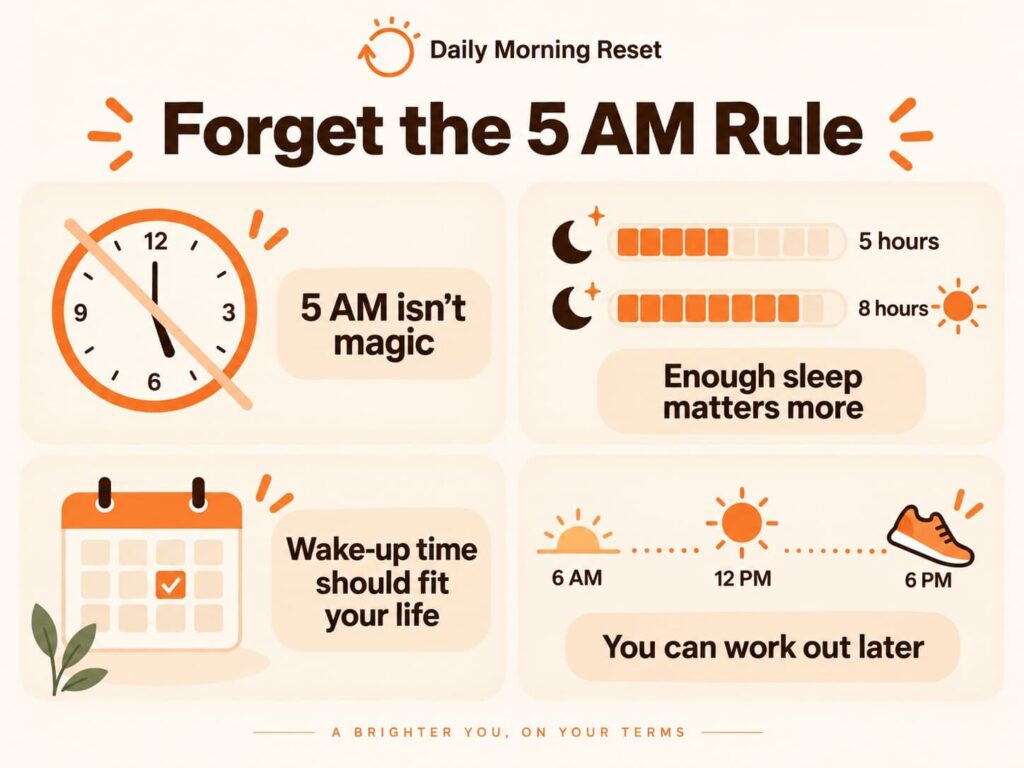
There is no special prize for waking up at 5 AM.
If that time works for your job or family, great.
If you go to bed late and force yourself awake early because it sounds disciplined, you are probably just making yourself tired.
Wake-up time should fit your life.
Someone who sleeps properly and wakes at 8 may have a much better morning than someone struggling through a 5 AM routine on five hours of sleep.
That matters more than the clock.
The same applies to morning exercise. Some people genuinely love it. Others feel terrible until they have been awake for an hour.
Do the workout later if that suits you better.
You are allowed to spread healthy habits across the day.
Build the Routine Around Your Worst Morning
This is one of the easiest tests for whether your routine will last.
Imagine you slept badly, woke up late, and have a busy day ahead.
Which parts of your routine would you still do?
Those are probably your core habits.
For me, a sensible backup morning routine list would be something like:
- Open the curtains
- Drink something
- Wash up and get dressed
- Move for a minute or two
- Choose the first important task
That is enough to give the morning some structure.
The next day, you can do more.
People often give up on routines because they treat them as all or nothing. A good morning routine for success should be flexible enough to survive the odd bad morning.
Miss a workout or skip journaling? Nothing fell apart. You had a busy morning, so pick it up again tomorrow.
Make Your Own Checklist, Not Someone Else's
The easiest way to build your routine is to choose five to eight habits that already make sense for your life.
Do not copy every step from this article.
Your list might look like this:
- Get up and open the curtains
- Drink water
- Make coffee
- Wash up and get dressed
- Walk for five minutes
- Eat if hungry
- Pick the main task
- Start work
Another person might need school drop-off in the middle. Someone else might work nights and start their “morning” at noon.
That is fine.
The best morning routine checklist for adults is not the one with the most habits. It is the one you can use without constantly thinking about it.
Keep the order roughly the same for a couple of weeks.
Once one habit starts leading naturally into the next, you may not need the morning routine checklist anymore.
That is usually a good sign.
What About a Printable Morning Routine Checklist?
Some people like seeing habits on paper, especially when they are trying to build a routine from scratch.
If that is you, keep it simple.
A free printable morning routine checklist should not look like a school worksheet. Five to eight boxes are enough.
You could use:
- Wake up and get some light
- Drink water
- Move for five minutes
- Wash up and get dressed
- Breakfast or coffee
- Choose today’s priority
- Start the day
Leave one blank line for anything that changes.
The checklist is there to remove decisions, not create more things to manage.
If you find yourself worrying about checking every box, shorten it.
What Makes a Morning Routine Worth Keeping?
A good morning routine is usually pretty ordinary.
That is why it works.
You wake up, get some light, drink something, move around, take care of yourself, and decide what needs doing.
There is no dramatic transformation happening every day.
The value comes from repeating useful things until they stop feeling like tasks.
Some mornings will still be messy. You will oversleep sometimes. You will spend too long on your phone sometimes. You might skip breakfast or forget the walk.
None of that matters much.
A routine is something you return to, not something you perform perfectly.
If you want more structure, our 10-minute rule ebook by Daily Morning Reset can help you build a routine around your schedule instead of forcing yourself into somebody else’s.
The goal is simple: make your morning easier to start and easy enough to repeat.
Build a Better Morning in Just 10 Minutes
Get the complete 10-minute morning routine with simple steps, practical habits, and clear guidance you can use every day.
Build a Better Morning in Just 10 Minutes
Get the complete step-by-step system with habit tracker, guided templates, and real-life examples.
Morning Routine For
Success eBook
FAQs: Morning Routine Checklist
What if mornings just are not my thing?
That is fine. Keep your routine short and focus on getting yourself properly awake.
How much do I really need to do?
Probably less than you think. A few useful habits are enough if you can stick with them.
Can I check my phone when I wake up?
Yes. Just be careful with scrolling, because that is where ten minutes can disappear fast.
What if I oversleep?
Drop the extras and move on. Get ready, grab what you need, and start with the most important thing.